
Why Store-Bought Paver Sealer Fails Fast in Florida
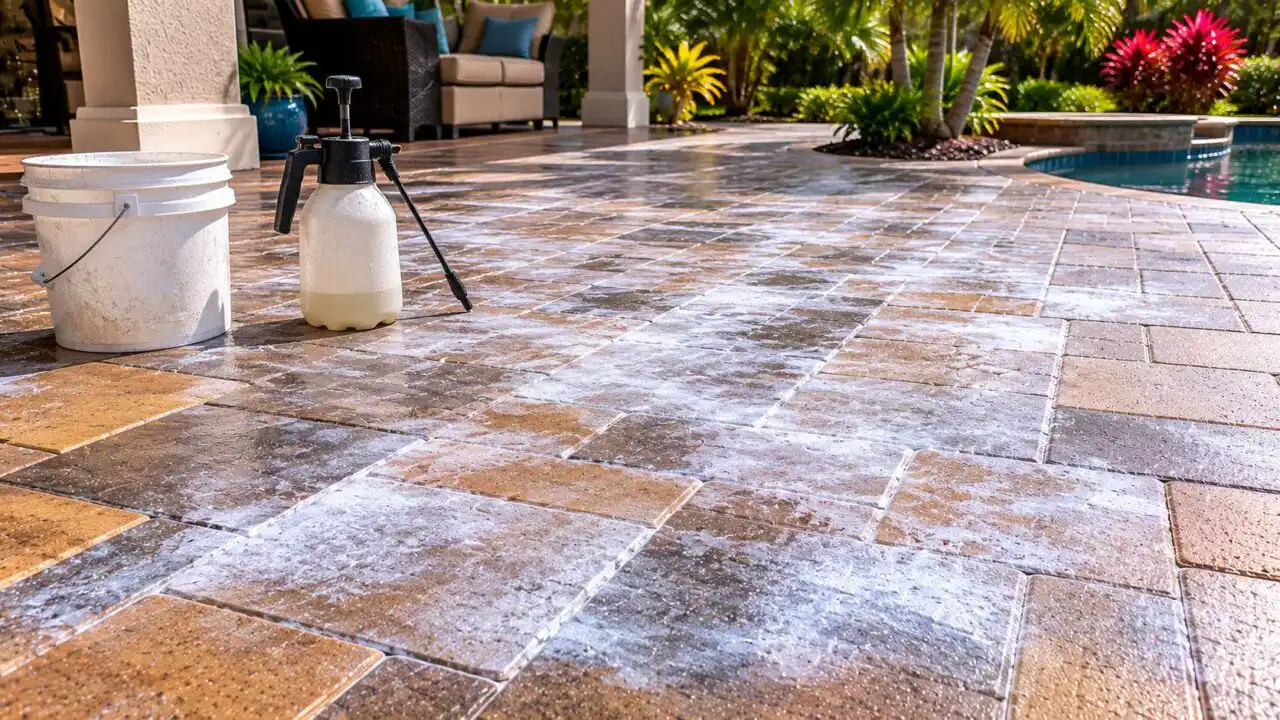
Walk into any home improvement store and you will find paver sealer on the shelf, which makes do-it-yourself sealing look easy and cheap. But store-bought sealer tends to fail fast in Florida, and fixing that failure usually costs far more than doing it right the first time.
Choosing the best paver sealer for Florida is about more than grabbing the nearest bucket. Here is why off-the-shelf products struggle in our climate, and what actually makes a seal last.
Why Store-Bought Paver Sealer Fails Fast
Most consumer-grade sealers are made from cheaper materials that are not formulated for Florida’s heat and moisture. Our humidity, heavy rain, and intense sun put far more stress on a seal than the average climate, and budget products simply are not built for it.
The common result is a sealer that turns white or cloudy, darkens the pavers unevenly, or peels within a season. Once that happens, you are looking at stripping the failed product and starting over from scratch.
It is frustrating because the pavers often look great the day the DIY job is finished. The problems show up weeks later, after the first stretch of heat and afternoon storms goes to work on a product that could not handle them.
It is worth saying that this is not about blaming homeowners for trying. The marketing on these products makes them look foolproof, and the failures are rarely obvious until well after the job is done, so the deck is stacked against a good outcome from the start.
At Wet Seal Paver Solutions, our team has spent years protecting paver surfaces across the Tampa Bay area.
The Moisture Problem
Florida pavers need a sealer that lets moisture escape. Concrete pavers naturally hold and release moisture, and if the sealer traps it underneath, you get a white, hazy bloom or a milky finish coming from below the surface.
Many store-bought sealers do not breathe properly, so they trap that moisture and fail. A sealer chosen for Florida conditions is formulated to protect the surface while still letting the pavers release moisture, which is what prevents the whitening and darkening that ruin a DIY job.
This single issue is behind a huge share of the failed seals we see. It is not always that the homeowner did anything wrong, it is that the product was never going to work in our climate to begin with.
Temperature swings make this worse. Pavers heat up dramatically in the Florida sun and cool at night, and a sealer that cannot flex and breathe with that cycle tends to cloud, crack, or lift over time.
It Is Not Just the Product, It Is the Process
Even a decent sealer fails without the right prep, and prep is where do-it-yourself jobs usually fall apart. The pavers need a thorough cleaning, treatment for efflorescence, mold, and stains, and proper joint sand before anything is applied.
Application matters just as much. The first flood coat has to saturate the joints to lock the sand in, and that takes the right volume and technique. A pump sprayer or a quick roll-on rarely delivers it, so the seal comes out thin and uneven.
These steps are easy to underestimate from a quick how-to video. In practice, the difference between a lasting seal and a failed one is mostly in the preparation and the application, not just the bucket you bought.
Matching the sealer to the specific pavers matters too. Different paver types and finishes call for different products, and a one-size-fits-all bucket off the shelf cannot account for that, which is part of why DIY results are so hit or miss.
What the Failure Really Costs
The appeal of store-bought sealer is the low price, but a failed DIY seal erases those savings fast. Stripping cloudy, peeling, or hazed sealer is labor-intensive and delicate, and it has to be done before the pavers can be sealed correctly.
So the cheap bucket often turns into the most expensive route: the cost of the product, the cost of the failure, and the cost of a professional redo. Doing it once, correctly, is almost always cheaper than doing it twice.
There is a time cost too. A DIY weekend that has to be redone professionally a month later means more disruption, more waiting, and a longer stretch before you can actually enjoy your pavers.
Professionals also stand behind the work. When a company seals your pavers, you have someone accountable for the result, whereas a failed DIY job leaves you on your own to diagnose and fix whatever went wrong.
The Right Sealer, Applied the Right Way
The best paver sealer for Florida is a professional-grade product matched to your specific pavers and applied with proper prep and technique. That combination is what stands up to our climate and lasts for years.
It also means the finish comes out even and consistent, with the color protection and stability you wanted in the first place, instead of a gamble that may or may not hold.
We use the right sealer for Florida conditions and apply it correctly, handled by our paver sealing service. Thinking about sealing your pavers? Call us at 813-809-4440 or request a free estimate before you reach for a store-bought bucket.